4pagination-right pagination-right Shopping bag 4pagination-right pagination-right small medium large cable vouge the-times2 forbes new-york
Female sleeping with earplugs

Best reusable earplugs for side sleeping

Our earplugs for sleeping

Happy Ears Earplugs Original Discovery Pack

Original Discovery Pack

$37.50
View product
Happy Ears Ocean Plastics Earplugs package

Ocean Plastics Discovery Pack

$37.50
View product

“I’m a side sleeper and have used moldable wax earplugs. Is there a more comfortable earplug for side sleepers?”

Quick answer: Yes. The best earplugs for side sleepers are low-profile, reusable plugs with a stem under 10 mm that sits flush under a pillow. Happy Ears reduce sound by 27 dB (CE-certified), come in three sizes (96% fit rate), last about a year per pair, and cost $20–$25/year — vs ~$100/year for wax. With the Discovery Pack we have a money-back guarantee.

Moldable wax earplugs are widely recognized as being quite comfortable. The downside to wax is they tend to cap out at just 17 dB of sound reduction typically making them the least effective an any earplug. Lastly is the cost. Moldable wax earplugs are, by far, the most expensive solution for sleep. If you’ve used wax earplugs you know that “cheap” $5 package tends to last just 10-14 days as the earplugs can rarely be used more than two times. Use the earplugs to sleep every night and this low up front cost runs into more than $100.00 per year – Not cheap.

Enter Happy Ears of Sweden – The makers of the original reusable earplug. After serving more than 1mil customers, since 2010, they can say Happy Ears fit 96% of ears. If you’re one of the 96% you’ll see Happy Ears are comfortable and effective. Compared to other reusable earplugs Happy Ears keep a very small profile in one’s ear and and this is very important for side sleepers. The earplug does have a stem, but it’s less than 1cm (or a 1/3 of an inch for you Americans) and quite soft. Also when tilted upwards the stem tends to sit naturally inside the “outer ear” as if it isn’t even there. What’s best is Happy Ears are CE Certified to reduce volume 27 dB, making them much more effective than any moldable option. If the earplugs are working for you the final benefit is the cost. Most will use a single pair of Happy Ears for approximately one year meaning you’ll spend just $20-$25USD. You’ll sleep better saving so much on Happy Ears.

Whether you’re a side sleeper or not, start with one of their Discovery Pack starter kits and they guarantee you’ll sleep better.

How Happy Ears compare for side sleeping

Type Profile against pillow Sound reduction Material Lifespan Cost / year of nightly use Fit options Verdict for side sleepers
Happy Ears (reusable oval) Low — oval body with short stem (under 10 mm) tucks into the outer ear 27 dB SNR (CE-certified) Soft thermoplastic elastomer (TPE), hypoallergenic ~1 year per pair with daily use $20–$25 3 sizes (S / M / L) — fits ~96% of ears Designed for the use case. Oval shape matches the ear canal; short stem minimises pressure when the ear meets the pillow.
Disposable foam Medium — cylindrical foam sits inside the canal but can be pushed deeper as the pillow compresses it 29–33 dB NRR Polyurethane foam Single-use (1–2 nights typically) $50–$100 One universal size High dB rating, but compression against a pillow can cause discomfort and ear soreness over a full night.
Moldable wax Very low — molded by the wearer, sits flush in the outer ear ~22 dB NRR Wax + cotton fibre 2–4 uses per pair $80–$120 One moldable size Excellent flush profile. Lowest noise reduction of the reusable / semi-reusable options. Replaced often.
Moldable silicone Very low — flush in outer ear ~22 dB NRR Silicone putty 2–3 uses per pair $60–$100 One moldable size Similar profile to wax. Can adhere to hair. Mid-range cost and noise reduction.
Custom-molded Very low — professionally fitted to the ear 20–30 dB attenuation (varies) Medical-grade silicone 2–5 years $150–$300 (one-time) Custom-fitted by an audiologist Best long-term fit; highest upfront cost; requires a fitting appointment. Overkill for most snoring partners.

A note on dB standards: NRR (US) and SNR (EU/CE) measure attenuation differently — SNR values typically run 2–3 dB lower than NRR for the same product. Happy Ears’ 27 dB SNR corresponds to roughly 25–26 dB NRR. Figures above use whichever rating is officially certified for each product category.

Frequently asked questions about side sleeping with earplugs

Can you sleep on your side with earplugs in?

Yes. Side sleeping with earplugs is safe and common, as long as the earplug is low-profile enough that the pillow doesn’t press it deeper into the ear canal. Reusable earplugs with a short stem (under 10 mm) and an oval body, like Happy Ears, are designed specifically to sit flush against the pillow without discomfort.

Will earplugs hurt my ear when I sleep on my side?

They shouldn’t, provided you’ve selected the correct size and the earplug has a low profile. Soreness or pressure when side sleeping almost always points to a sizing issue — either too large for your ear canal or a stem too long for your outer ear. Happy Ears come in three sizes (S / M / L) and fit roughly 96% of ears.

Do earplugs fall out when you roll over?

A properly fitted reusable earplug stays in place through the night, including when you change sides. Foam earplugs can shift more easily because they expand inside the ear canal and lose grip as they decompress. Reusable oval-shaped plugs grip the natural curve of the ear canal and remain seated through normal movement.

What’s the most comfortable type of earplug for side sleeping?

Reusable, low-profile earplugs are widely considered the most comfortable for side sleepers, because they don’t expand against the canal and don’t protrude from the outer ear. Moldable wax sits flush but offers less sound reduction (around 17–22 dB). Reusable oval-shaped earplugs balance both: comfort under a pillow and 25–27 dB of noise reduction.

How many dB of sound reduction do I need to block a snoring partner?

Most snoring sits between 50 and 75 dB at close range, so 25–30 dB of attenuation is enough to bring it below the level where it will reliably wake a light sleeper. Happy Ears are CE-certified at 27 dB SNR, which is sufficient for the great majority of snoring partners. Louder snoring or thin walls may benefit from layering an earplug with a white-noise machine.

Are reusable earplugs hygienic for nightly use?

Yes, when cleaned regularly. Reusable earplugs made from medical-grade thermoplastic elastomer can be rinsed with mild soap and water and air-dried between uses, which removes earwax and bacteria. This is more hygienic than reusing foam earplugs, which absorb moisture and wax and cannot be properly cleaned.

How long do reusable earplugs last with nightly use?

A single pair of Happy Ears typically lasts about one year of nightly use, depending on cleaning routine and ear chemistry. This works out to roughly $20–$25 per year — compared with $50–$100 per year for disposable foam and $80–$120 per year for moldable wax, both of which need frequent replacement.

Do I need different earplugs for side sleeping than for back sleeping?

Not necessarily — but side sleeping is more demanding. Back sleepers can use almost any earplug type comfortably, while side sleepers need a low-profile shape that won’t be pressed deeper into the canal by a pillow. If you’re a back sleeper who occasionally sleeps on your side, a low-profile reusable earplug covers both positions.

Can earplugs cause ear infections or earwax buildup?

Used and cleaned properly, no. Earplugs don’t cause earwax production, but they can prevent the natural outward migration of wax if worn 24/7. Wearing earplugs only for sleep, cleaning them regularly, and avoiding insertion into a fully wax-blocked ear canal keeps the risk negligible.

What’s the best earplug size for side sleeping?

The right size depends on your ear canal, not your sleep position. Most adults wear Medium, but a meaningful share are Small (especially women and people with narrow canals) or Large. The most common sizing mistake is choosing one size too large, which causes pressure and the sensation that the plug is sinking into the ear when lying on your side.

Ear plugs for sleeping

An earplug for side sleepers.

According to the National Library of Medicine side sleeping is preferred by 60% of adults and is considered to be the healthiest sleep position. Side sleeping offers many benefits including improved spinal alignment and a reduced risk of snoring, heartburn and back pain.

Today you’ll find many pillows and blankets to benefit side sleepers. What about and earplug?

Designed and made in Sweden, Happy Ears earplugs have helped more than 1mil customers sleep better. We know through our daily interactions with customers, since 2010, that many of these customers are side sleepers. Four reasons side sleepers love Happy Ears:

Happy Ears are offered in three sizes with a unique oval shape and short soft stem.

Aside from the earplugs not expanding in your ears, Happy Ears are also shorter than traditional foam earplugs. The circumference of the earplug’s stem is less than half that of a traditional earplug. Happy Ears simply have a smaller profile in your ear making the earplugs more comfortable for side sleepers.

Side sleeping puts quite a bit of pressure or stress on an earplug. It’s important that side sleepers choose a durable earplug. Most will use a single pair of Happy Ears, daily, for one year.

The Happy Ears Discovery Pack money back guarantee. If you’re a side sleeper we make it easy to discover the perfect earplug for your ears. Each of our Discovery Packs offer the same no time limit money back guarantee.

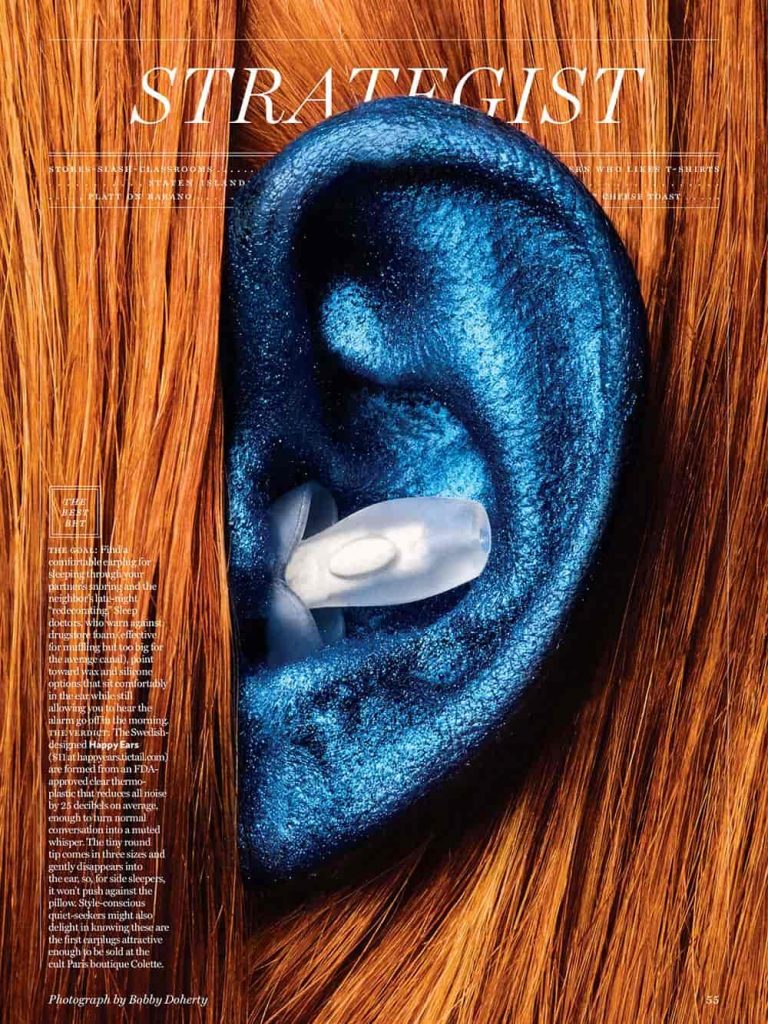
Strategist magazine cover showing blue ear with happy ears earplugs in

Story – The Complexity of Sleep

Best Earplugs for Sleeping – New York Magazine